
Paul Kagame’s Rwanda
A fully blacked-out Land Cruiser creeps along the running track inside a packed Amahoro national stadium, in the heart of Rwanda’s capital, Kigali. It is followed, a few metres behind, by a black Mercedes, driving at a somewhat brisker pace. As it approaches the halfway mark of the track, the Mercedes rolls to a halt. A bodyguard alights from the front passenger seat and swiftly opens the car’s rear door. A tall, slender man emerges, buttoning his suit with one hand, and waving to the roaring crowd with the other. Paul Kagame has arrived for his presidential inauguration.
Much like his grand arrival, Kagame’s victory at the polls is everything but subtle: against a reported turnout of 98.2% of eligible voters, 99.2% of ballots are cast in his favour. The state broadcaster RTV displays the electoral map — it is a clean outline of Rwanda, uniformly shaded in sky blue, the colour of Kagame’s Rwanda Patriotic Front (RPF). The party has managed to improve on its 2017 performance, when it received a comparatively modest 98.8% of the vote. At this rate, full national consensus is only two elections away.
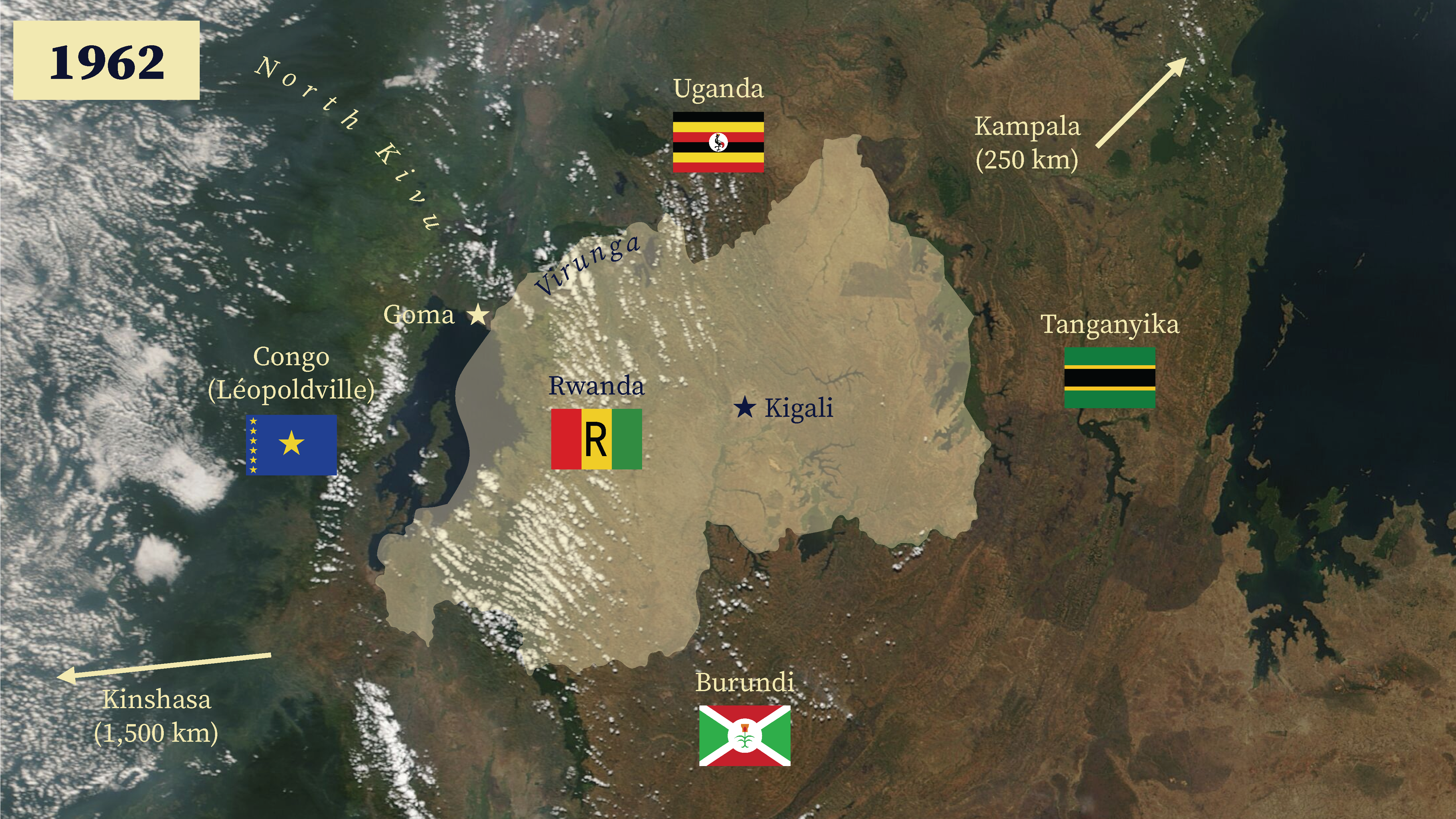
As the Amahoro stadium rejoices to the Rwandan military band’s rendition of Azabatsinda Kagame — a patriotic song roughly translating to ‘‘Kagame will destroy them’’ — some 120 km to the west, a rebel militia known as the M23 is preparing to strike deep in the Democratic Republic of Congo’s (DRC) lush, mineral-rich North Kivu province. A few days later, 25 civilians are dead, many of them children. As Kagame rushes to deny any Rwandan involvement in the M23 movement, the West slowly watches his mask peel away — struggling to pretend it hadn’t seen the stitches all along.
Paul Kagame has long walked a fine line between saviour and sovereign. His iron grip over Rwanda is enforced through human rights abuses, military interventions, political arrests, censorship, extrajudicial killings — and of course, electoral manipulation — all allegations he vehemently denies. Yet, the news seems not to have reached Western ears. Abroad, Kagame remains a celebrated figure: he is routinely invited to lecture at some of the world’s most prestigious universities on the sanctity of human rights; his regime’s name sits emblazoned on the jerseys of major football clubs; Western donors finance a significant portion of Rwanda’s national budget; and the small East African nation has emerged as a sought-after tourist destination, with visitor numbers more than doubling in the decade leading up to the Covid pandemic.
For all the controversies that shadow his rule, Kagame is still hailed by many as a unifying and stabilising regional force. Since storming Kigali at the head of the RPF’s armed wing in July 1994, he has been widely praised around the world for his free-market policies and for steering Rwanda through a remarkable period of development. Maternal mortality has fallen by over 70%; poverty has been cut in half; GDP has grown nineteen-fold; life expectancy has risen by more than two decades in just as many years; and the country is now home to the continent’s first end-to-end vaccine manufacturing plant. But above all statistics, Kagame has been commended for his role in promoting the rapprochement between Rwanda’s two main ethnic groups: the Hutu majority and the Tutsi minority. And in that reconciliation, the echo of one of humanity’s darkest crimes is slowly fading into silence.
Though they speak the same language and pray to the same God, Hutu and Tutsi have long been divided by a deep imbalance of power. When Europeans first set foot in Rwanda in the late 19th century, the predominantly Hutu farming communities were already subject to the feudal authority of the largely Tutsi herding elite. This social hierarchy would only persist, and in fact become further entrenched, under German and later Belgian colonial rule.
Born into a Tutsi family, Kagame experienced firsthand the upheaval of this centuries-old social order, as Rwanda violently transitioned, in the early 1960s, from a Tutsi monarchy administered from afar by Belgian colonial authorities, to a Hutu-dominated independent republic. As the country’s social fabric unravelled, hundreds of thousands of Tutsi fled to Uganda and other neighbouring nations to escape the burgeoning wave of ethnic violence. There, a generation in exile began to nurture hopes of return — and amongst them, a young Paul Kagame.
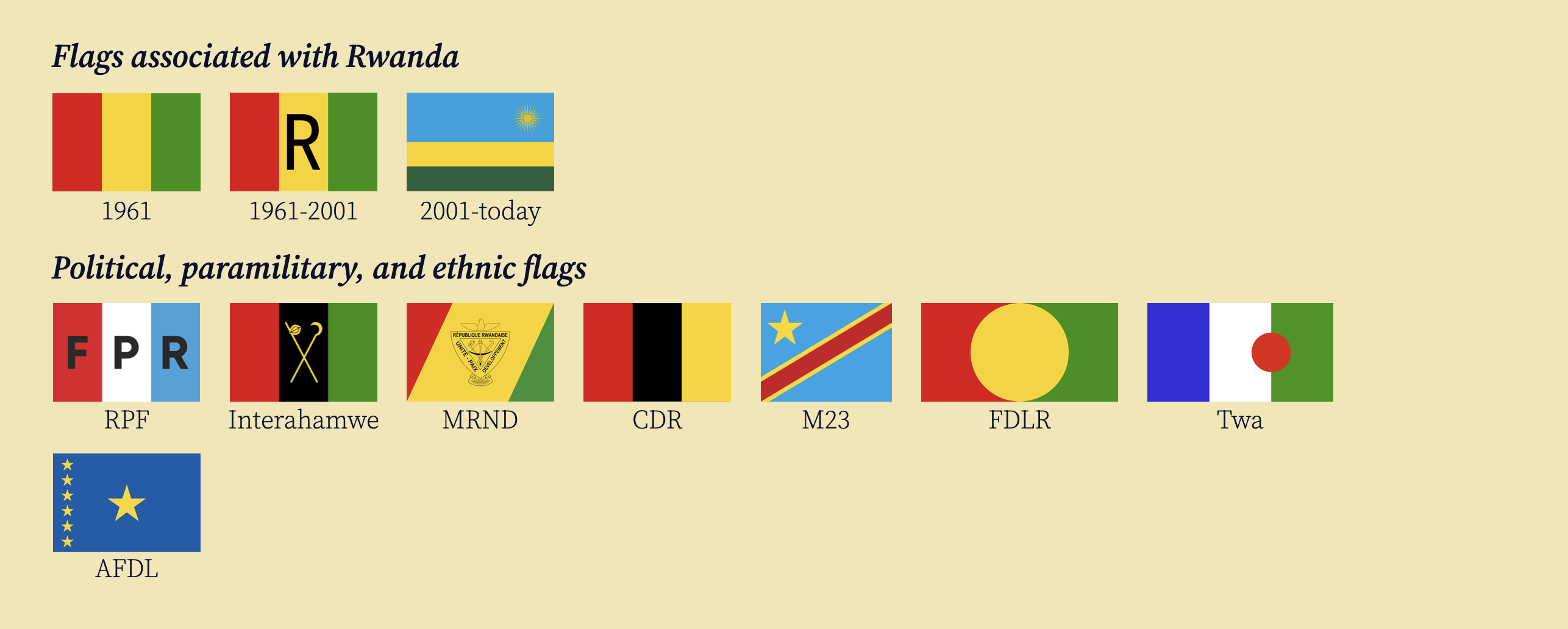
The full picture of Kagame’s legacy comes into focus only when set against the backdrop of the Rwanda he inherited over 30 years ago. By the early 1990s, the country was standing on the brink of economic collapse. With the fall of international export quotas, volatile free-market forces had taken hold of the global prices of coffee — the lifeblood of the young Rwandan republic’s economy. Cornered into deep spending cuts, President Habyarimana of the National Revolutionary Movement for Development (MRND) party oversaw a period of austerity that plunged entire communities into poverty. Concurrently, the liberalisation of Rwanda’s political space offered an opportunity for Hutu hardliners — both within Habyarimana’s own party and in the extremist Coalition for the Defence of the Republic (CDR) movement — to formalise their vision into what would become the radical Hutu Power movement.
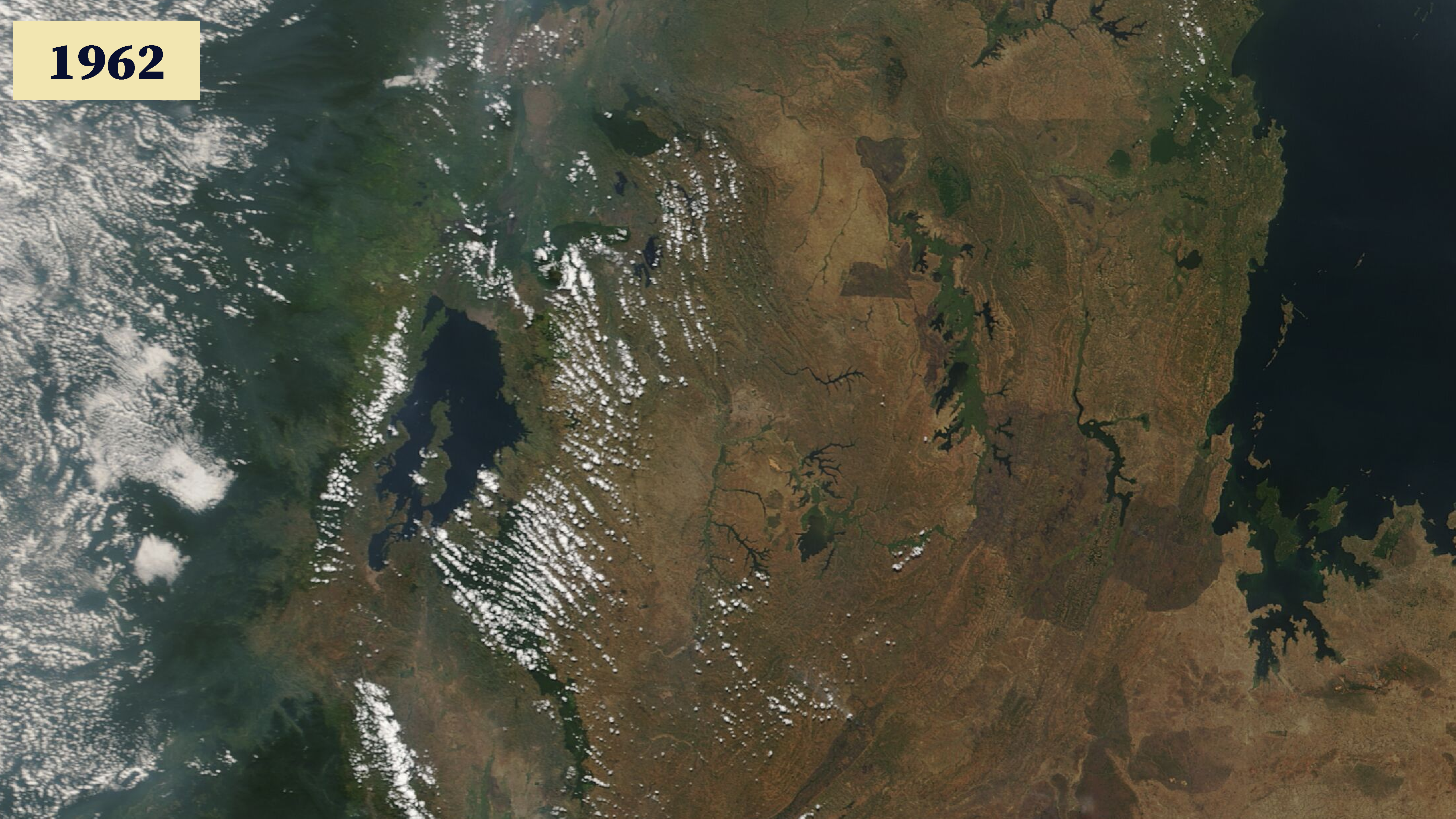
Meanwhile, less than 70 kilometres to the north, the newly formed RPF was quietly gathering strength. Life in Uganda had initially offered little refuge to the Tutsi exiles: Kagame and others faced renewed ethnic persecution, this time at the hands of the Ugandan regime. Throughout the 1980s, many Tutsi refugees, including Kagame, joined the National Resistance Army (NRA), a guerrilla movement embedded in the region’s Anglophone political and military orbit. After the NRA seized power in 1986, the newly installed government in Kampala would prove a decisive ally in the RPF’s struggle.
Kagame’s RPF first invaded Rwanda in late 1990, when thousands of rebels, still clad in their Ugandan army uniforms, stormed chaotically across the border. At the time, Kagame was thirteen thousand kilometres away, attending military training in Kansas. As the RPF’s offensive began to collapse in on itself, he boarded the first flight back — military textbooks still under his arm — and retreated the Front to the Virunga mountains, in the country’s northwestern frontier.
Kagame’s 1991 reorganisation of the RPF foreshadowed many of the values and methods that would come to define his three decades of rule over Rwanda. From atop the 4,500-metres-high Virunga volcanoes, he reshaped the RPF into a tightly disciplined and meritocratic force, favouring the calculated efficiency of technocratic governance over the emotional appeal of populist politics. He demanded of his soldiers unconditional loyalty and absolute obedience; breaches of his code of conduct often carried fatal consequences. Just as finely planned as his guerrilla tactics was the narrative Kagame wove around the RPF: by promoting several Hutu officials through its ranks, he succeeded in recasting the Front not as a narrow ethnic insurgency, but as a broad-based national liberation movement.
Indeed, Kagame has long been meticulous in curating the RPF’s image in the eyes of international observers. Today, he does so through high-profile sponsorship deals and gorilla naming ceremonies. In the early 1990s, it was through guns and diplomacy: when early peace talks with the central government collapsed in 1993 — undermined by the growing influence of the Hutu Power movement — Kagame marched straight towards Kigali. Then, just 30 kilometres north of the capital, he halted the RPF’s advance and declared a ceasefire. With the Front in striking distance of the city, he was able to negotiate from a position of strength, while avoiding the risk of alienating international observers through a direct and bloody assault on the capital. Thanks to his tactical acumen, he secured significant concessions from President Habyarimana: the RPF’s territorial gains in the north were formally recognised; a demilitarised buffer zone was established between the Front and the central government; and a plan was drafted to gradually integrate the RPF’s armed wing into the Hutu-dominated national Rwandan Armed Forces (FAR) on equal terms. The Rwandan civil war appeared to be moving towards a peaceful resolution.
Before the Arusha peace accords could be implemented, however, Rwanda plunged once more into chaos. The skies over Kigali suddenly lit up as a Dassault Falcon 50 business jet plummeted towards the earth below, violently torn apart by two surface-to-air missiles. It was the plane of President Habyarimana, and in the years that followed, blame for its downing would come to rest on almost everyone and anyone — from Hutu extremists to Kagame himself. Regardless, the President’s assassination — followed just hours later by that of the prime minister and her UN security detail — created a power vacuum that was rapidly filled by the FAR, still deeply infiltrated by the Hutu Power movement, and by the state-sponsored Hutu paramilitaries known as the Interahamwe — literally, ‘‘those who fight together’’. And to the Interahamwe, the collective fight was also an existential one: the RPF’s advance was not a military campaign, but the return of the old Tutsi order — the feudal lords of a bygone era now coming to reclaim power.
So began Rwanda’s darkest hundred days. Some 800,000 Tutsi, along with more moderate Hutu, were slaughtered by machete-wielding, banana-beer-fuelled Interahamwe. Amidst the fratricidal horror, pulpits preached violence, classrooms taught fear, and hospital wards turned into killing grounds. Politicians crisscrossed the country to galvanise any flagging Interahamwe. Radio speakers announced the locations of the inyenzi: the ‘‘cockroaches’’, as the Tutsi were called. ‘‘The graves are only half full’’, denounced one RTML host. ‘‘Who will help fill them?’’
The curious predicament Kagame finds himself in today can be traced, in large part, to the West’s actions, or lack thereof, during the 1994 genocide. The massacre of the Tutsi people unfolded in plain sight of the UN peacekeeping mission; even as its observers helplessly issued appeals for support, the international force was slashed to a tenth of its original size. American and French diplomats actively worked to prevent the massacre from being formally recognised as genocide, insisting instead that it be framed within the context of a civil war. The United States, still haunted by the televised images of its soldiers’ corpses dragged through the streets of Mogadishu just months earlier, was deeply reluctant to engage in another African conflict. France, for its part, launched a military mission — not to protect the victims, but to shield the génocidaires fleeing west. To this day, France’s role in the Rwandan genocide remains highly controversial. At best, it can be described as a catastrophic misjudgement: a desperate attempt to preserve the Françafrique sphere of influence against the advance of the Anglophone RPF — one that rendered Paris deaf to the dying cries of the Tutsi people. At worst, France’s involvement remains buried in secrecy and silence.
Over the past three decades, seemingly paralysed by a guilt complex over its inaction during the Rwandan genocide, the West has shown extreme reluctance to criticise Kagame — the man who ultimately brought the massacre to an end, as he seized Kigali in July 1994. In the wake of the RPF’s victory, more than two million Hutu were displaced, as génocidaires and regular civilians alike fled the largely indiscriminate killing of the Hutu people. Fearing accusations of hypocrisy, Western powers carefully refrained from condemning the RPF’s retaliatory violence. In 1995, at the Kibeho refugee camp alone, RPF gunfire left at least 4,000 Hutu dead — a figure strongly disputed by the Rwandan government, which has consistently dismissed such incidents of anti-Hutu violence in Rwanda as isolated acts of revenge perpetrated by rogue soldiers.
In the decades since the 1994 genocide, overt ethnic violence in Rwanda has sharply declined, as the nation tries to forget rather than further divide. For years, the wise men and women of Rwanda’s villages have gathered beneath the mango trees, seated on plastic chairs before scores of men in pink prison uniforms. Upwards of a million direct participants in the genocide have been released back into society through these Gacaca courts — literally, ‘‘on the grass’’ — with only the supposed masterminds of the massacre sent to face the UN tribunal in Arusha, Tanzania.
This restoration of domestic stability should not go unacknowledged. In a nation where the majority of the population did not shrink from the task of extermination, where Catholic priests allowed their own churches to be bulldozed with thousands of Tutsi still praying inside, where tens of thousands of women walked the streets bearing in their wombs the aftermath of the Interahamwe’s rapes, where it was all but uncommon to pass your brother’s killer on the way to the marketplace, how could one be expected to tolerate — let alone reconcile?
Sectarianism is now constitutionally prohibited in Rwanda, and ethnic labels no longer appear on national ID cards. In place of explicit violence, internal stability is now maintained through more covert means. Opposition figures are routinely arrested on conspiracy charges, and many have died under suspicious circumstances while in police custody. Kagame’s Rwanda consistently ranks among the world’s lowest for political liberties, and falls within the bottom fifth globally for press freedom. Spyware and other surveillance tools have been detected on the phones of Kagame’s dissidents and allies alike. Prominent critics of his regime have been assassinated abroad — strangled in hotel rooms in South Africa, shot in drive-by attacks in Kenya, gunned down in Ugandan pubs, or found dead at sea off the coast of Mozambique.
If the RPF’s violent hand has delivered relative stability within Rwanda — regardless of what has been sacrificed to achieve it — the same cannot be said for the lands and peoples beyond its borders. In particular, Kagame has long harboured strategic ambitions in the Kivu regions of the Democratic Republic of the Congo (formerly Zaire), a mineral-rich area home to more than half of the world’s known reserves of coltan — a critical ore used in electronic devices — alongside vast deposits of gold and cassiterite. Over the years, hundreds of armed groups have emerged to contest control of the region’s lucrative mines. Rwanda is widely believed to operate through its proxy militia M23, as well as through a disparate network of Banyamulenge fighters — members of an ethnically Tutsi community descended from Rwandan migrants, whose claim to Congolese identity has been a recurring source of political tension in the country.
While Kagame’s current operations in the Kivu regions have so far stopped short of a full-scale invasion, his RPF forces did cross into Congo at least twice in the years following the 1994 genocide. The first incursion came in late 1996, when Rwanda — citing the need to eliminate the Hutu génocidaires operating in eastern Zaire under the aegis of long-time dictator and Françafrique client Mobutu — orchestrated the AFDL rebellion that quickly ousted the cancer-stricken autocrat. During that conflict, Rwandan-backed forces were implicated in the deaths of over 200,000 Hutu refugees. A draft UN report later accusing Rwandan troops of acts that could amount to genocide was delayed and softened, allegedly after Kagame threatened to withdraw his forces from the UN peacekeeping mission in Darfur.
Kagame invaded Congo again in 1998 — this time, to depose the AFDL leader Laurent Kabila, whom he had helped install as president of the reborn Democratic Republic of the Congo (DRC) just a few months before. Kabila had quickly grown wary of his patrons in Kigali and Kampala, and moved to expel all foreign military advisors from the DRC. The ensuing war drew in armies from across Africa and became the world’s deadliest conflict since WWII, claiming more than five million excess deaths. Kabila himself was assassinated by child soldiers in 2001, and the war formally ended two years later.
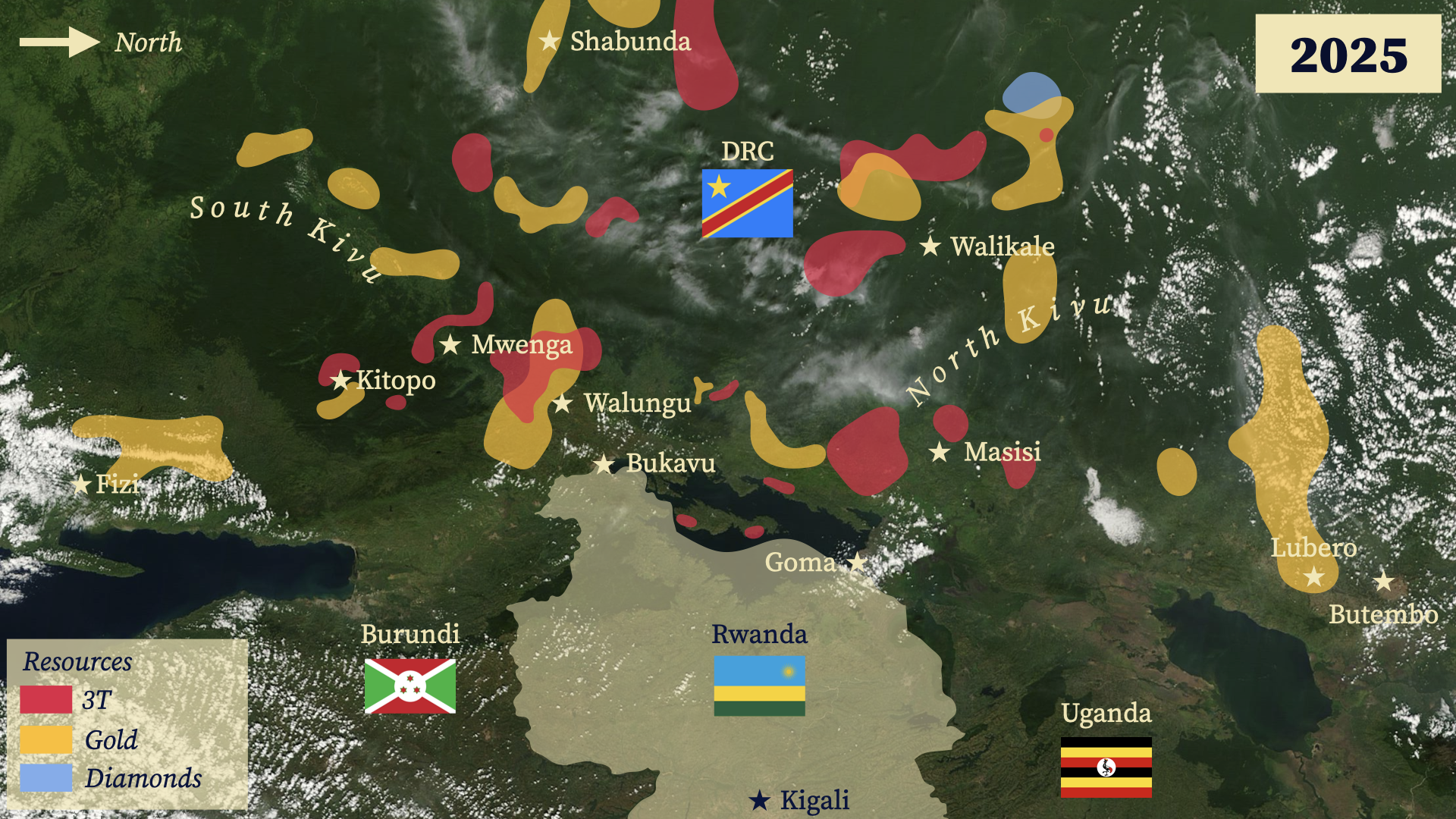
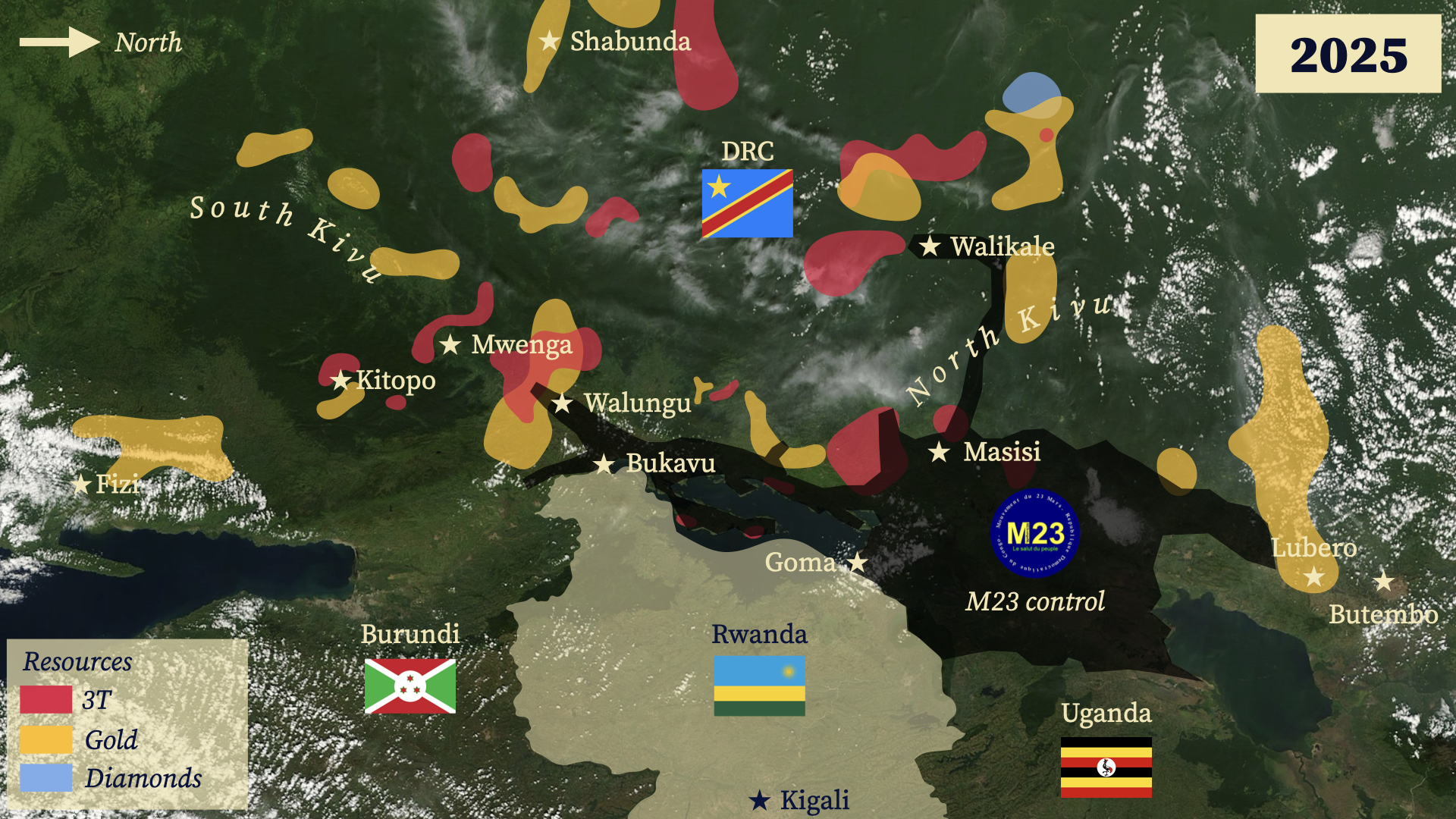
Today, the Kivu provinces remain at the mercy of countless armed groups. Among the most prominent is the loosely organised local self-defence force known as the Mai-Mai — a name derived from its soldiers’ practice of using water as a shield against bullets. The Hutu génocidaires also remain active in the region, operating primarily under the banner of the Democratic Forces for the Liberation of Rwanda (FDLR), a rebel movement that Kigali regards as an existential threat to its national security. The current landscape is that of a highly fluid web of shifting alliances and internal factionalism. While the Mai-Mai groups and the FDLR génocidaires are broadly aligned in their opposition to Rwanda’s M23 proxy force, they have also violently clashed with one another, as well as with the FARDC, the Congolese national army. Other groups, such as the Islamic State-linked jihadist forces of the ADF, further complicate the picture. Rwanda itself is believed to maintain a contingent of some 4,000 troops fighting alongside the M23, while the UN’s 10,000-strong MONUSCO peacekeeping mission remains deployed in the east.
The North Kivu capital of Goma, a city of nearly 2 million people, has become a focal point in the struggle for control over eastern Congo. In late 2012, M23 rebels briefly captured the city, before international pressure and sanctions against Rwanda enabled the central government to regain control. In recent years, however, the M23 group has resurfaced, and in early 2025, it seized Goma once again — resulting in more than 2,000 casualties and exacerbating the region’s humanitarian crisis.
This time around, the West appears more reluctant to denounce or sanction Rwanda’s advance into eastern Congo — likely, a reflection of Kagame’s growing political and strategic leverage. He is now the world’s second-largest contributor to UN peacekeeping missions, and Western powers increasingly hold vested interests in the region. Just months after UN experts estimated that 120 tonnes of Congolese coltan are smuggled into Rwanda each month and mixed with domestic production, the EU signed a minerals deal with Kagame’s government. Rwandan troops now guard French oil and gas projects in Mozambique against jihadist attacks, and a billion-dollar minerals deal with the United States is reportedly in the works. Kagame’s regime, it seems, has become one too useful for the West to confront — and Congo, long dismissed as a lost cause, may simply be left to pay the price for its own expendability.

Suggested further reading:
- Rwanda: The Legacy of Hate, the Pulitzer prize-winning series written by Dele Olojede ten years after the genocide;
- Revisiting Rwanda 30 Years After the Genocide, Time Magazine, written by Jonathan M. Hansen;
- Rwanda, the West’s ‘Donor Darling,’ Seizes an Opportunity in Congo, The New York Times, by Ruth Maclean
- The strongman reshaping central Africa, Financial Times, by David Pilling
221 reader(s).
To receive our latest articles as they are published, please consider subscribing to our newsletter — just enter your email address below and click ‘Subscribe’

Leave a reply…